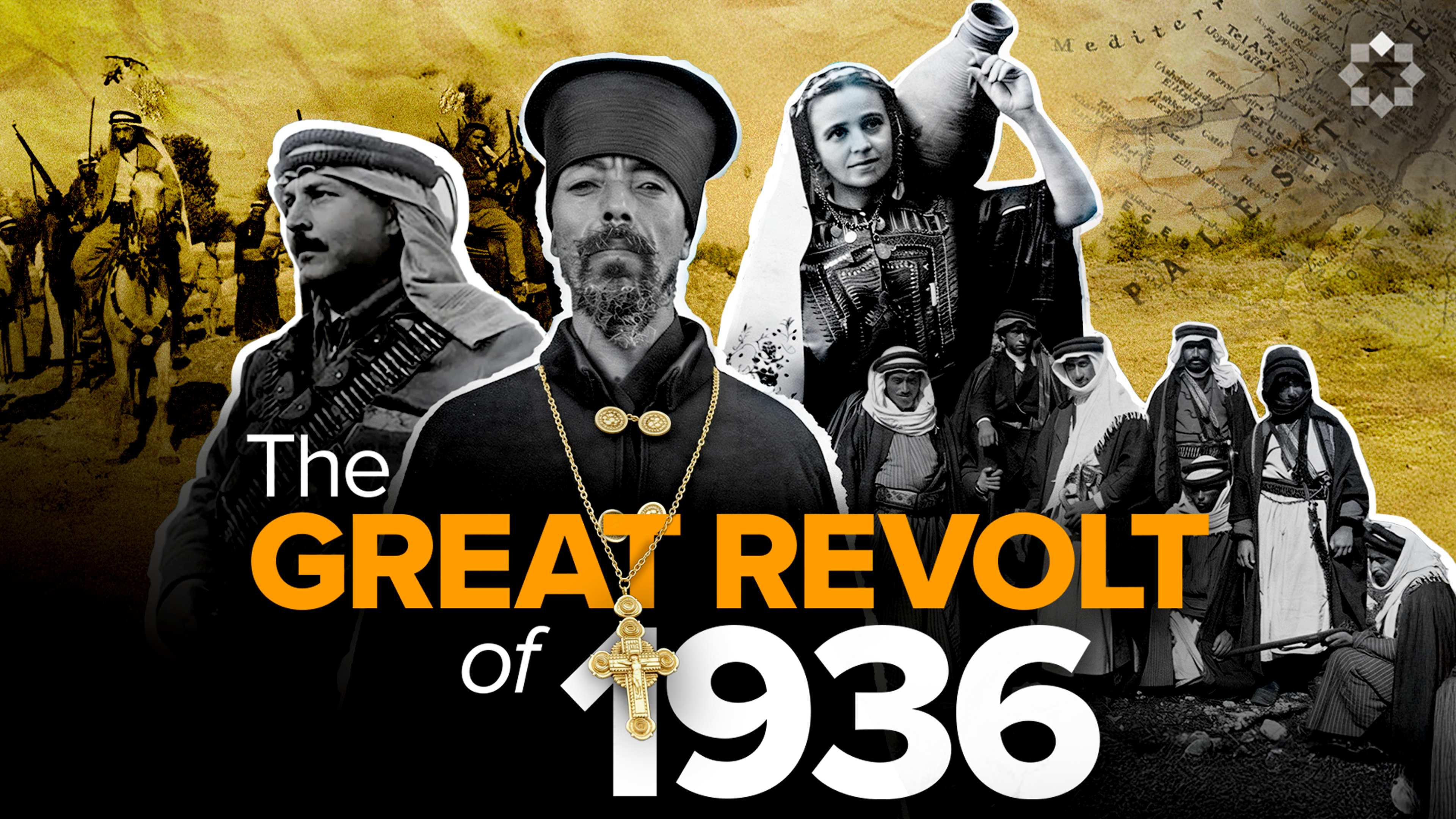
Look closely at this stamp. A church and mosque side by side. It is a piece of evidence the British Empire tried to bury, because it proves something they didn't want the world to know,
that in Palestine, Muslims and Christians moved as one. It's a very clear and familiar strategy: pin the Christian against the Muslim, divide and conquer by teaching division without context.
Such methods are seldom new. Those in power have always thrived on fracture, filing away the fuller story and replacing it with a singular, simplified narrative. And it's
time to set the record straight. This narrative of Muslim versus Christian is a lie. And even in the Holy Land, they moved as one.
In the age of civilization and light, there was strength and darkness. And you understand enough, because we are fed up with speech. Our goal is to raise the flag with complete independence.
These were the words of Nuh Ibrahim, repeated throughout Palestine in the 1930s in streets, in cafes, in churches, and in mosques. Search the Great Revolt today. Google shows you a war
from 1900 years ago. Search 1936 Palestine, a footnote. The largest anti-colonial uprising of the 20th century, erased from the first page of history. Today, if we search why the
Great Revolt failed, we get the same tired answer: internal division, a story of sectarian strife, a divide carefully invented. Terrorism is turning into open revolt in Palestine,
and British troops and police are up against a tough proposition. With every Arab nationalist, any apparently peaceful citizen may be carrying a bomb. In April 1936, the Palestinians launched
what they called Al-Thawrah Al-Kubra, the Great Revolt. It came after the 1917 Balfour Declaration and the 1920 British Mandate for Palestine, which turned promise into policy. Land transfer
to Zionist settlers, labor systems favoring Jewish workers over their Muslim and Christian counterparts, and an economy reshaped in ways that left Arab unemployment rapidly rising.
Farmers were crushed by increasing taxes and by senseless violence, with British forces killing farmers and their livestock indiscriminately. British forces raided and
terrorized many villages, burning homes and shops, raping civilians, including women and boys, and killing men, women, and children without justification. The Palestinians petitioned,
they pleaded, they protested, and they were ignored. The British continued their torment, and this went on for 16 years. The Great Revolt of 1936 was an organized resistance
against British colonial rule, land dispossession, and accelerating Zionist settlement. Later, Western historians would rebrand it as the Arab Revolt, a subtle narrowing that
stripped it of its full story, because in reality, this was a national uprising. Palestinian leaders, Muslim and Christian, formed the Arab Higher Committee. Workers' unions
mobilized. Farmers joined strikes. Merchants closed shops. Palestinians held one of the longest general strikes in modern history, over six months of total commercial shutdown.
But the story was shaped to set Palestinian Muslims and Christians against each other, as though the mothers of the dead had not wept over the same graves or grieved in the same taffeta dresses. Now let's go back to the original Arab records,
the oral and written testimonies, the photographs that the British and Zionists buried, and let's restore the memory of a united people fighting for each other.
This memorandum, written and signed by leaders of both faiths, and submitted to the British High Commission, called for an immediate halt to British-facilitated Palestinian dispossession
through forced migration, opposed the institutionalized inequality between Arabs and Jews, demanded that all Muslims and Christians be allowed to live in peace, and called for a
democratic government. Yet the British continued to act upon the Balfour Declaration, completely disregarding the Indigenous people of
Palestine, Muslim and Christian alike. This was a national stamp, a church and mosque standing side by side, a symbol founded by revolutionaries like Abd al-Rahim al-Hajj Muhammad, also known as
Abu Kamal, one of the central commanders of the revolt. Born near Tulkarem, Abu Kamal grew up working the land. A World War I Ottoman Army veteran, he returned to work the land after his
father's death, until British economic policies bankrupted him. And in 1934, he suffered another blow. His wife died, leaving him alone to care for their four young sons. Locals came together and
decided that an alternative to diplomatic negotiations was needed, as these memorandums and appeals were falling upon deaf ears. So the idea of armed struggle against British rule and
their sponsorship of Zionism began to spread, and Abu Kamal was appointed commander of a largely peasant Fallah force. With his sons placed in the care of his sister, Abu Kamal met them for a
day or two each week in secret, honoring both his fatherhood and his role as a leader. A disciplined military organizer, Abu Kamal forbade looting and personal vendettas. Everywhere he went, he
emphasized the unity of the Palestinian cause. But the British colluded with Zionist forces to continuously sow hatred. The British began dispersing leaflets that made Christians feel
like the Muslims were harming them, and Muslims feel like the Christians were not really with them. It was classic divide-and-rule propaganda, often spreading fabricated claims that a certain
commander had assaulted a prominent figure, carefully designed to ignite anger and suspicion. Leaflets lettered with lies, a perpetual Zionist tactic, used again and again.
By far the coldest accusation levied against the Muslims during the Great Revolt was the killing of Christian leader Mishal Mitri. Mitri was the president of the Society of Arab Workers in Jaffa. The point of this society was to confront and obstruct the Zionist settler
colonial plans. Mitri was foundational in organizing the labor strikes. He was one of the first Palestinian political prisoners, and he was Christian. Muslim leaders came to visit him,
and this is photographic evidence of the camaraderie between them and Mitri. He was released soon after and returned immediately to his advocacy. In December, he attended a union meeting in Jaffa, and as he stepped outside,
a masked gunman called to him and fired at close range. The bullet entered beneath his ear and exited through his cheek. The murderer was never caught.
In the narrow streets of Jaffa, Jews are taking revenge on Arabs for past murders, while on the beach next door, their friends are having mass dances to cover their return.
In the centuries since, British authorities, Zionist forces, and many Western historians have promoted one explanation: that internal Palestinian divisions led to his murder, blaming feudal rivalries or ideological clashes within Arab society.
However, the Palestinian narrative has consistently rejected this. Why would Mitri, focused on the plight of Palestine, be killed by his own people? There is no plausible reason for
any Palestinian faction to kill him. According to Arab accounts, the assassination was a deliberate and premeditated act orchestrated by Zionist forces with the intention of destabilizing
the Arab resistance movement and delegitimizing its cause. But Muslim and Christian leaders kept pushing their case. No taxation without representation. Christian leaders even
emphasized that the British mandate need not show concern over Christian holy sites, as the Muslims had always adequately protected and safeguarded them. Letters, memorandums, meetings,
every legal, professional, and proper method to defend their homeland, to have dignity and rights, fell on deaf ears over and over again.
By 1937, the British shifted the scheme. They recruited known criminals, armed them, and directed them towards Palestinian villages where acts of intimidation, violence, and looting would follow. The British called them the peace bands.
They were ordered to ambush networks and fracture Palestinian society, often making it look like Muslims were attacking Christians or vice versa. In response, among the leading Muslim families, Abdel Qadir al-Husseini was tasked with overseeing
Jerusalem and Bethlehem, where the majority of the Christians lived, protecting villages and organizing local defense. Abdel Qadir was the son of the mayor of Jerusalem,
Musa al-Husseini. Just two years before the Great Revolt, in March 1934, at the age of 80, Musa was leading a peaceful protest, but was brutally beaten by the British,
with the injuries eventually leading to his death. His father had stood in protest, and now he would stand in battle. Abdel Qadir al-Husseini gathered fighters and moved against
the gangs, breaking their grip and shielding the targeted communities. The Arab revolt remains a grave problem. Troop reinforcements pour in to help put down the terrorism against Jewish
inhabitants. The British responded with overwhelming force: infantry, artillery, armored vehicles, even aircraft, a full-scale assault against the local population. The
imbalance was staggering. Violence raged for months, a brutal year of the British forces versus the so-called rebels. In September of 1937, following the assassination of a British
district commissioner, the British Mandate Authority declared martial law and dissolved
the Arab Higher Committee. Abdel Qadir al-Husseini fled to Iraq in 1938, but returned years later to
die a martyr near Jerusalem. In the same way Palestinians face collective punishment today, the British did not differentiate between the Christians or the Muslims when it came to
punishment, so they were tortured alike. And by 1939, the revolt was crushed. Propaganda campaigns promoted British authority and discouraged remaining insurgency. But the
numbers didn't add up. Palestinian Christian men killed by the British were tallied only as Christian deaths, not Arab, suddenly shifting blame onto Muslims. Meanwhile, the land grab
continued, settlements expanded, and the dispossession deepened. The British keep writing history their way, tucking away oral testimonies, letters, signatures, mountains of proof that tell
a completely different story. The so-called crusade narrative thrives on fear. It reduces billions of people to caricatures and keeps communities locked in suspicion.
When that language resurfaces in modern politics, it gives cover to deeply anti-Muslim rhetoric, and it justifies an American warmongering attitude against Muslim nations.
A Christian versus Muslim framing fixates on wars and clash, often overlooking the far more common stories of companionship and shared common history. This is where the lie stops.
We began this video with stanzas by Nuh Ibrahim, the poet of the people who fought with lines of Levantine poetry that have been erased from British archives. His writings were always
about resilience, resistance, and national solidarity that transcends religious and political boundaries. Nuh Ibrahim was killed at the mere age of 25 on a Friday in Ramadan
on October 28, 1938. His dead body was thrown into a well by the British, only to be retrieved by locals and mourned in Tamra. On this anniversary of the Great Revolt, we refused the lies.
It was British colonial policy and Zionist settlement organizations that brought blood and betrayal, death and division to the Holy Land. There are no walls between the Christians
and the Muslims of Palestine, and our occupiers did not distinguish between us then or now.