
Jump to:
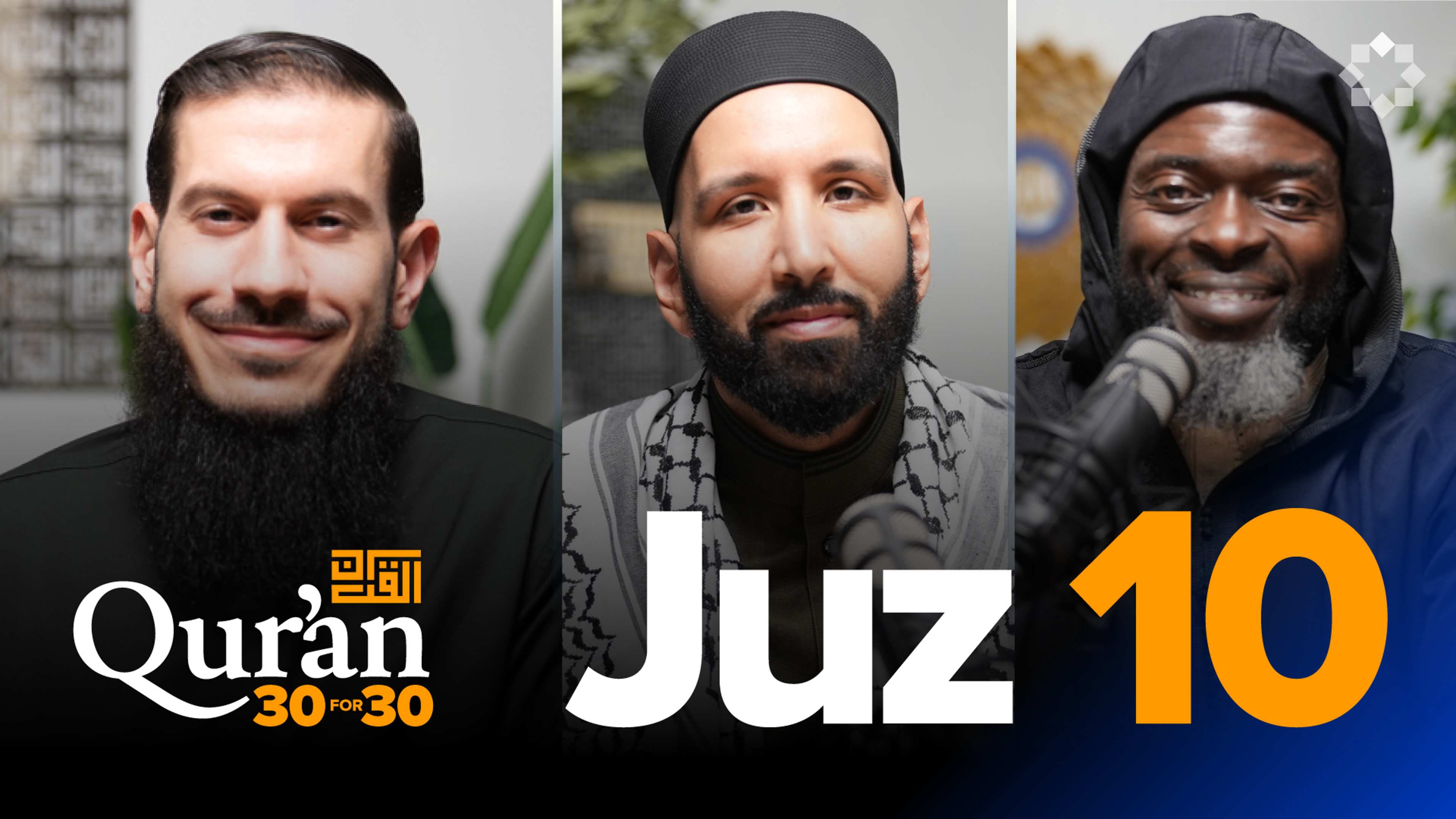
Qur’an 30 for 30 | Season 7
Juz 10: When Allah Goes To War For You | Dr. Suleiman Hani
Many people struggle to love and obey a fictional god they have created in their minds—instead of learning what Allah has taught us about Himself.
Dr. Suleiman Hani joins Dr. Omar Suleiman and Sh. Abdullah Oduro for a deep reflection on verses from Surah al-Anfal and Surah al-Tawbah, exploring moments of uncertainty, trials, and divine tests.
Names of Allah discussed: Al-Azeez, Al-Hakeem, Al-Sami, Al-Aleem
This transcript was auto-generated using AI and may contain misspellings.
People are so angry, uh, or refuting or responding to the God that they created in their minds. It's just a notion of God that's not real, and it's very problematic because Muslims are not immune from that. There's times where you can—there can be stress, there can be levels of uncertainty. That's when you activate the
'aqeedah, and you activate that trust in Allah Subhanahu wa Ta'ala. Don't think you're fooling Allah Subhanahu wa Ta'ala. Mm. Jameel. Because Allah hears and Allah sees. السلام عليكم ورحمة الله وبركاته everyone. Welcome back to
Quran 30 for 30. I want to remind you all, بإذن الله تعالى, to tune in to the Ramadan series as well as donate to Yaqeen بإذن الله تعالى. We're getting into that slow patch, which is the middle 10 days. May Allah Subhanahu wa Ta'ala accept our entire Ramadan,
where, uh, many people start to slack off, but it may be that your forgiveness is in these middle 10 days. So do not let Ramadan escape you in its middle. May Allah Subhanahu wa Ta'ala bless you all and accept from us all. اللهم آمين. Um, الحمد لله
رب العالمين. We have with us today, uh, Shaykh Suleiman Hani. May Allah Subhanahu wa Ta'ala bless you. Uh, repeat guest, الحمد لله رب العالمين. I think last year you did Surah At-Tawbah too, by the way. Probably did. I don't—it's been six years now, right? Uh, it's been too many years, Alhamdulillah. You did
Surah At-Tawbah last year or the year before? I did, yes. And next to you is, uh, the Grim Reaper man, Shaykh Abdullah Duro. That outfit—he wanted me to just put this to start off like this and then flip it up. Shaykh, you look like you're
about to snatch Shaykh Suleiman's soul, like in—ah. Well, no, he's talking about tawbah. I can't, you know. I don't want to be Malik al-Mawt or anything like that. No tashbih or anything. Shaykh Suleiman, how are you? الحمد لله رب العالمين. الحمد لله. الحمد لله, Shaykh. It's good to have you again. الحمد لله
رب العالمين. Uh, Shaykh, what's your favorite name of Allah Subhanahu wa Ta'ala? I'll put you on the spot right away. That's the question, Shaykh. Yeah, that's the point. It's got to be the first thing that comes to mind. Can I do a pair? It's related to the theme. Uh-huh. Okay. Oh, nice segue. Uh,
that's still tough. It depends on what you're going through, what the Ummah's going through at the time, what comes to mind. And that's the amazing thing about the scope of the names of Allah Subhanahu wa Ta'ala. Uh, but amongst them, of
course, is الرحمن الرحيم, uh, and العزيز الحكيم. The pairing of these two is very powerful, uh, philosophically, theologically, psychologically, emotionally. Helps you navigate all types of situations. Alhamdulillah.
Alhamdulillah. So insha'Allah ta'ala, we are going to go ahead and get started. So we are now in Juz 10, Alhamdulillah, and we are looking at Surah Al-Anfal into Surah At-Tawbah. Looking at how Allah Subhanahu wa Ta'ala speaks about Himself, it's actually really interesting. I
was looking at just the first few verses, um, in this Juz. Look at how they all end, the first few verses. والله على كل شيء قدير Allah has power over all things. First verse. Second verse. وإن الله لسميع
عليم And verily, Allah is All-Hearing, All-Knowing. And then إنه عليم بذات الصدور Verily, Allah knows what's in the hearts. And then وإلى الله ترجع الأمور And to Allah return all affairs. So this is a very rich Juz
in terms of the, uh, dynamic pairing of the names of Allah Subhanahu wa Ta'ala. In fact, if you just took, like, those few verses and you don't even know the context, Allah Azza wa Jalla is talking about how
He knows all of the circumstances. And all of this has to do with wartime situations, where things seem most chaotic. And SubhanAllah, in the time that we live in right now, you know, how do
you see through the rubble of Gaza? How do you see through the dust of war? How do you see through starvation and famine? How do you see through these things? And there is both assurance as well as warning that is coming through these verses. But
what I wanted to focus on, uh, sort of big picture with how Allah Azza wa Jalla talks about Himself in this Juz, you know, I was looking, SubhanAllah, at the end of Surah Al-Anfal. Allah Subhanahu wa Ta'ala
praises Hijrah, and He praises the believers sort of in their best manifestation when they went out in Badr and when they made Hijrah. These are two, like, shining moments of the Mu'minin, the believers. They're going out in Badr,
and they're going out in Hijrah. And so the very last verses وَالَّذِينَ آمَنُوا مِن بَعْدُ وَهَاجَرُوا وَجَاهَدُوا مَعَكُمْ فأولئك منكم So Allah Subhanahu wa Ta'ala mentions those who later believed and migrated and struggled alongside you,
that they are also with you. So Allah is praising Hijrah. Allah is praising, you know, الجهاد في سبيل الله Allah is praising, like, these people who put it all on the line, and they were willing constantly to be with the Prophet (ﷺ) in his most
difficult times. So your best manifestation is Badr and the Hijrah with the Prophet (ﷺ) and those that came afterwards in the same spirit, right? And then, SubhanAllah, look in Surah At-Tawbah, right? It's Tabuk. It's
like the exact opposite, your worst manifestation, where you're dragging your feet, you're slow, you're making excuses, uh, it's uncomfortable, there's a capacity issue. And Allah Subhanahu wa Ta'ala is checking the intentions of
the believers. It's like, I know what's going on on the inside that's manifesting itself in a certain way on the outside. And so there's a lot of, uh, emphasis in these verses on Allah Subhanahu wa Ta'ala's knowledge of
what's really going on here, what is actually happening, uh, with all of this. And then I want to focus on these two verses. So Allah Subhanahu wa Ta'ala says in Surah Al-Anfal, let's see if you can catch, uh, not both of you, of course, respected mashayikh, but those
of you that are following along, like, what's the connecting, uh, link between these two verses? Surah Al-Anfal, verse 60, Allah Subhanahu wa Ta'ala says, وَأَعِدُّوا لَهُم مَّا اسْتَطَعْتُم مِّن قُوَّةٍ وَمِن رِّبَاطِ الْخَيْلِ تُرْهِبُونَ بِهِ
عدو الله وعدوكم Allah Subhanahu wa Ta'ala says, and prepare against them what you can of your power and your strength, uh, to deter the enemies of Allah and your enemies. So the enemies of Allah and your enemies. Then in
the next surah, Surah At-Tawbah, uh, verse 51, Allah Subhanahu wa Ta'ala says, قُل لَّن يُصِيبَنَا إِلَّا مَا كَتَبَ اللَّهُ لَنَا هُوَ مَوْلَانَا. Okay? Say that nothing will befall us except what Allah
Subhanahu wa Ta'ala has decreed for us. He is our Mawla. هُوَ مَوْلَانَا He is our protector. So I found it very interesting, SubhanAllah, this particular connection where Allah Azza wa Jalla, had He simply said, "The
enemy of Allah," that would have been sufficient. Or had He said, "Your enemy," that would have been sufficient because the other is implied, right? If they are your enemy because you are believers, they're the enemy of Allah Subhanahu wa Ta'ala. But Allah Azza wa Jalla specifies the
enemy of Allah and your enemy. And here, هُوَ مَوْلَانَا attributing Allah Subhanahu wa Ta'ala to yourself as your Mawla. He is your protector. And that takes us back to, of course, the Battle of Uhud, when Umar (رضي الله عنه)
called out at the instruction of the Prophet (ﷺ) الله مولانا ولا مولى لكم "Allah is our protector and you have no protector." This actually, SubhanAllah, really highlights that as much as Allah Azza wa
Jalla is distancing Himself, especially as we start to get into Surah At-Tawbah, which is a very difficult Surah, may Allah Azza wa Jalla protect us from being of the hypocrites, as much as Allah is doing Bara'ah, right? He's distancing Himself from the hypocrites. He's bringing the
believers closer. To say that they are my enemy and your enemy, and Allah is telling you to call upon Him as your protector, our protector, our Mawla, right? And of course, the ahadith are many in this regard,
مَنْ عَادَى لِي وَلِيًّا فَقَدْ آذَنْتُهُ بِالْحَرْبِ the very famous Hadith Qudsi that whoever takes, uh, a friend of mine as an enemy, then I will wage war against that person. So Allah Subhanahu wa Ta'ala is
bringing the believers closer. Allah Azza wa Jalla is showing us in the midst of this chaos that some are truly shining. And we ask Allah Subhanahu wa Ta'ala, in the midst of the fitan of our time, that we are amongst those that shine as well.
Allahumma Ameen. And so this Juz, uh, is very much so Allah Azza wa Jalla being acquainted and Allah Subhanahu wa Ta'ala giving access to certain people, right? Privileging certain people and bringing them closer
as He's disavowing, uh, Himself from others, right? Which is which is very heavy, um, and and very, uh, difficult. So Shaykh Suleiman, uh, first of all, any any thoughts from the mashayikh before we go
on to specifics? It's powerful, honestly. I, a lot of thoughts were coming to mind, connecting, of course, the Sirah, uh, and not just the Sirah, but the the Prophets before and their stories in the Quran to, uh,
protection from Allah, companionship, and how it applies, uh, to the collective and to the individual. And oftentimes people forget, as they're watching, whether it's Gaza or Sudan or East Turkestan or any type of oppression,
anywhere around the world, really, they forget to apply that experience of companionship for, the Ummah to their own personal struggles, or they may even belittle some of their struggles.
ذَٰلِكَ بِأَنَّ ٱللَّهَ مَوْلَى ٱلَّذِينَ ءَامَنُوا۟ وَأَنَّ ٱلْكَـٰفِرِينَ لَا مَوْلَىٰ لَهُمْ Uh, these are strong words and strong verses about these issues, um, but they protect us from being desensitized and forgetting and distracted. And it's a reminder for the believers to feel comfort in that and to find
inspiration through that. We ask Allah to protect us all around the world. Ameen, Ameen. So, any thoughts? No, Masha'Allah, just seeing how even they verbalize it, هو مولانا, it's kind of to remind yourself internally and to remind those around
you. Because at times where you can there can be stress, there can be levels of uncertainty. That's when you activate the 'aqeedah and you activate that trust in Allah Subhanahu wa Ta'ala and that which is dormant sometimes within you. When you say it, there's a benefit of adhkar
in general. When you mention Allah Subhanahu wa Ta'ala's name, it reminds you of His greatness, particularly His different names and attributes and how they're manifest in different ways. And particularly this context of that which is, you know, lives being lost or possibly being lost and people being tested. You don't know who the munafiqun
are. Trusting in Allah Subhanahu wa Ta'ala is paramount in these particular situations. So it's beautiful. Shaykh Suleiman, I'll come to you first. In verse 49 of Surah Al-Anfal, Allah Subhanahu wa Ta'ala pairs off the two
names, Al-'Aziz Al-Hakim. And obviously, um, these two names are frequently, uh, paired together, and you mentioned them, uh, as as your favorite or your second favorite. I mean, I asked you for one name, you gave four, but that's okay. We'll let it go,
insha'Allah. But what is the relationship between these two names and tawakkul, right? This is a very specific context, the trust in Allah Subhanahu wa Ta'ala with Al-'Aziz Al-Hakim.
So the verse 49 context, إِذْ يَقُولُ الْمُنَافِقُونَ وَالَّذِينَ في قلوبهم مرض the hypocrites say, and those who have spiritual diseases in their hearts, غَرَّ هَٰؤُلَاءِ دِينُهُمْ uh, they're talking about the believers who see, uh,
perfection in Allah Subhanahu wa Ta'ala, and they're trusting in Allah Subhanahu wa Ta'ala as though they are deluded. So they're talking about us and the Ummah by extension, uh, as delusional. Uh, and Allah Subhanahu wa Ta'ala immediately responds to it with the pairing of these
two names, reminding us, فَإِنَّ اللَّهَ عَزِيزٌ حَكِيمٌ um, Allah Subhanahu wa Ta'ala reminds us about tawakkul with these two names, وَمَن يَتَوَكَّلْ عَلَى اللَّهِ So, there are a couple of things that come to mind
amongst them. We recognize this is not just a description of hypocrites from a theological or philosophical perspective. It's also a diagnosis. And, uh, what's interesting is, generally speaking, in the philosophy
of religion, uh, I think the most common conclusion by far, uh, that I came to. So I did a lot of philosophy of religion, unfortunately, but it's it's been very beneficial, Alhamdulillah. But the most common
thing that I kept noticing is people are so angry, uh, or refuting or responding to, or distant from or arrogant towards a God that they created in their minds. It's just a notion of God that's not real. And it's very problematic because Muslims are not immune
from that. A Muslim may struggle to think of God in His perfection, uh, to remember that Allah is 'Aziz, meaning there's no deficiency whatsoever in any of His attributes, uh, and also Hakim. And what's amazing about
this pairing with regards to tawakkul is the munafiqun are watching the believers in Madinah and thinking, against all odds, impossible odds, really, from a worldly lens, uh, the believers are still strong, they're resilient. And of
course, that's not far from reality today. And it hurts because, uh, we're watching this unfold all the time, uh, the most livestreamed genocide of our times, and strife and
fitna all around the world in many different ways. And it inspires the people who are good, and their fitrah has something still good in it, so they're inspired by the resilience of Ghazzans. And it causes those who are far from God, and they have the wrong notion of God,
to become more arrogant. So they say, "You guys are crazy. You're literally in the midst of genocide. You've lost so many people. You have nothing to be strong about, resilient through." And yet
they are, and they're inspiring us, and they're inspiring the world, and they're still, you know, adamant about something that really is, uh, bulletproof and genocide-proof, and that's trust in العزيز الحكيم. So that's the first part of it. It's a diagnosis,
and it's a reminder for all the believers to check their hearts and remember that Allah is perfect before and during a genocide, before and during a siege, before and during your own personal hardships and your challenges. The second point that comes to mind in terms
of trusting in Allah Subhanahu wa Ta'ala is that when you do fall into a misunderstanding about Al-'Aziz in particular, and I'll talk about both, but when you misunderstand Al-'Aziz,
the Almighty, the All-Powerful, what could happen is you either, on one side, you could become, uh, arrogant, or you can become powerless. It's interesting why, because this Muslims will notice this practice sometimes in themselves,
or this, uh, trait in in terms of their thoughts or their practices. Uh, and so the one who falls into either of the two spectrums, either thinks that, you know, they don't need God's power, or that there's there's nothing that, uh, they will gain from it, uh, whatsoever,
that God will not give them anything. And, uh, similarly with Al-Hakim, the one whose wisdom is perfect and puts everything in its proper place and executes and judges with perfection. Those who misunderstand Al-Hakim can also become
fatalistic on the one side, uh, or they they can become excessively controlling, thinking that, like the Qadariyyah and the Jabriyyah with their ideas of fate and destiny, uh, they they become excessively controlling. And so they start to think they can outsmart
God with something worldly or their own intellect, as people do all the time. And we see this in Zionists, just as we saw this in Quraysh, uh, and you saw this in the examples of Fir'aun. Or somebody will become, uh, fatalistic, and some Muslims may fall into
that, just completely giving up hope and feeling like nothing matters, and it's all in their in their minds, it's all written, so there's nothing really that I'm doing. It's more robotic, cause and effect. Al-'Aziz, Al-Hakim combined now, when you have the right notion of who God
is, uh, in this context and in all of our contexts, uh, you realize that you need both simultaneously, and God is both simultaneously. He's perfect in His authority and the fact that nothing is greater than Him,
no oppressor, no missiles, no genocide, no ethnic cleansing, no military, nothing of this world is greater than God. اللَّهُ أَكْبَرُ عَلَى كُلِّ ظَالِمٍ And the second, He executes that wisdom, that power with wisdom. So everything
of Allah's power is tied to His wisdom, and everything of His wisdom is tied to His power. So Allah Subhanahu wa Ta'ala will not disappoint. He's aware of what's happening. He's aware of your situation. He's aware of the overall picture that we cannot possibly imagine, that even to tie it back to what you started with,
Shaykh, when the angels asked, they don't understand the wisdom, they don't understand the picture, they don't have the power. When they asked about the creation of this being with free will, Allah Subhanahu wa Ta'ala suffices them with the response, إِنِّي أَعْلَمُ مَا لَا تَعْلَمُونَ I know that which you know not. And so through
the, you know, the drops of blood of every martyr in this world, every innocent person, uh, and the tears of every Gazan mother and the families around the world who are making du'a and begging Allah Subhanahu wa Ta'ala,
He's aware, He has authority. Allah Subhanahu wa Ta'ala reminds us there's a wisdom to this, and He only delays the people who oppress and the people of evil in this world for a little longer. إِنَّمَا نَعُدُّ لَهُمْ عَدًّا And on the Day of Judgment, perfect justice is
restored. So it's a reminder for us, no matter how dark the night is, no matter how difficult the storms of this world are, remember the One who controls the winds. We ask Allah to grant us full trust in His power and perfection. Ameen. You know, what I
think of Shaykh also, like the idea of where do you derive your 'izzah from, where do you derive your your honor from, your dignity from, your sense of worth from? Like when someone tells you you're crazy for believing in this all, you know, غَرَّ هَؤُلَاءِ like
you're you're delusional, basically, and they seem to be winning as well. They seem to be overcoming you and overpowering you. So it's a very compromising and compromised position sometimes, right? Like they're saying
you don't know what you're doing, you're crazy, you know, you still think you're going to win somehow, you still think there's some good that's going to come out of this. If you have an inferiority complex, like you you require validation from them, but if you have that trust
in Allah Subhanahu wa Ta'ala, Al-'Aziz, then you have 'izzah as well. You have a sense of honor from His authority, right? Because He is the One who grants honor. And so you're at ease with that. Like, I don't care what you say. I don't care if you're humiliating me because I
don't derive my sense of 'izzah from your validation, right? From your bestowal of validation. Like, you go ahead, say what you want, call me what you want, right? I wasn't seeking your approval in the first place. And then I
guess also clinging to Al-Hakim. While you're in the midst of that, like, why would Allah allow these horrible human beings to gloat? And that is Allah Subhanahu wa Ta'ala
being Hakim and you being at ease with His wisdom. No, that's beautiful. I mean, especially what's happening to our young men and women that are standing up in the name of justice and standing up for what is right, even though the majority may see it as wrong, or some may see it as delusional. They may
lose friends, maybe even some family members that have been, you know, disenchanted or jaded from what is happening from some of the Muslims or what's happening with what Allah has predestined. But it's beautiful how you mentioned that
they find their validity and they find their strength, uh, retreating to these names. But that does require a level of of understanding what these names mean and having some sort of relationship, you know, before the calamity, that so
when that calamity happens, it activates it even more and makes it even stronger. When that fitna happens, it's because of that trust you've had in Allah and the relationship you've had with Him, it activates it and it makes you even stronger. It's also, in a way, just an
additional comment you both reminded me of, mashayikh, is, that's real intelligence. Real intelligence is not, uh, like a worldly metric. Yes, you can have the worldly metrics, but real intelligence is to know that Allah Subhanahu wa Ta'ala has full knowledge of all things and perfect
wisdom in His execution, and His power is always there, even when He doesn't execute it in a way that we understand or delays it for reasons that we don't understand. So real intelligence is to recognize that you don't need to have the full picture. You don't need to understand all the wisdoms and the answers to the
question of why, uh, but rather to focus on the what. And that's what Allah tells us to do. In fact, what I really liked about all these aspects of of really difficulties and challenges and fitan and calamities in the Qur'an and in the Sunnah, in this
juz in particular, is and qadar in general, we're taught constantly to shift our perspectives away from the the question of why, uh, the why of everything, similar to the Why Me series, and to think about
the what. What should I be doing? What does Allah tell us to focus on and do right now with the circumstances that we have? We ask Allah to grant us and our brothers and sisters firmness. آمين. آمين. So Shaykh Abdullah, I'm going to come to you
just a few verses after. We kind of alluded to this, and it's a perfect segue. Verse 53, Mm-hmm, Allah Subhanahu wa Ta'ala pairs As-Sami' Al-'Alim, also very common, the All-Hearing and the All-Knowing. But it's
connected here to a change, right? A change in fortune, you know, a change in heart. So what does Allah Subhanahu wa Ta'ala's perfection in His hearing and His knowing have to do with change? Right?
So tawakkul sort of refers to the state of being. Change refers more to potential and where you can go. So what reflection can you share on this verse and this pairing? Yeah, this verse, SubhanAllah, بسم الله
والصلاة والسلام على رسول الله, it's beautiful because it serves as, as some scholars will call it a قاعدة or a general maxim when it comes to Allah, يعني how Allah deals with His servants because of what they put forth, the what, right? When
something happens, it's not about asking the why, but it's the what. And what do I do, or what have you done? And as a result of what you've done, consistently, there's going to be a response. And Allah Subhanahu wa Ta'ala is always going to respond to the
actions of His slave, whether it's good and whether it is not good. And SubhanAllah, Allah Subhanahu wa Ta'ala is talking about the fact that He gives blessings to all of His servants. And that's when He mentions, after He was talking about the munafiqun, He mentions, SubhanAllah,
this verse is in between talking about كَدَأْبِ آلِ فِرْعَوْنَ وَالَّذِينَ مِن قَبْلِهِمْ, ya'ni, as the way of the people of Fir'aun and those that came before them. He mentions that in verse 52, and He
says, كَفَرُوا بِآيَاتِ اللَّهِ فَأَخَذَهُمُ اللَّهُ بِذُنُوبِهِمْ ۗ إِنَّ اللَّهَ قَوِيٌّ شَدِيدُ الْعِقَابِ ۚ When He says that as the Fir'aun and the people that were with them, the case of the people that were with Fir'aun, what did they do? كَفَرُوا بِآيَاتِ اللَّهِ They disbelieved in the signs of Allah Subhanahu wa Ta'ala. So He
seizes them and akhdh is, is taking them with shiddah, with with with 'unf, with with aggression. And He took them because of their dhunub. And Allah Subhanahu wa Ta'ala is harsh against, He's harsh, has a harsh punishment because of what they used
to do. Then He brings the qa'idah here. He says, ذَٰلِكَ بِأَنَّ اللَّهَ لَمْ يَكُ مُغَيِّرًا نِّعْمَةً أَنْعَمَهَا عَلَىٰ قَوْمٍ حَتَّىٰ يُغَيِّرُوا مَا بِأَنفُسِهِمْ ۙ He says, this happened
because the seizing happened because Allah Subhanahu wa Ta'ala, He's bringing the general principle here, Allah does not, He does not change a favor of a people that He has bestowed upon them until upon a people
until they have changed what is in themselves or what they have or what or their attitude in some translations. What's beautiful here, SubhanAllah, this happened with كَدَأْبِ آلِ فِرْعَوْنَ ۙ وَالَّذِينَ مِن قَبْلِهِمْ Fir'aun and the people of them, their kufr and what
they did, their voluntary, voluntary consistent disbelief in the heart which showed in their actions, whether it was nifaq, that they said something and they disbelieved in their heart, or blatant disbelief in both cases. He says that's because
لَمْ يَكُ مُغَيِّرًا نِّعْمَةً أَنْعَمَهَا So He's saying He doesn't change the ni'mah that He has bestowed upon them. And what's beautiful here, He says, ni'matan, He doesn't change the blessing. Some would think the blessing from who? أَنْعَمَهَا that He has blessed upon them. So when we
talk about any blessings or any quote-unquote fortune that we've been given, that we exist in, and which is here just a waqfah, it's important to know that every single thing that we know of a blessing is from Allah Subhanahu wa Ta'ala. But imagine the things that we
take for granted and don't have in our conscious mind and realize at all times. This is why the remembrance of Allah, you can easily do so by thinking of anything that you've been given, starting with your senses and whatever the case may be, anything that you have and that you enjoy. That is a ni'mah from Allah.
It's a blessing from Allah. أَنْعَمَهَا عَلَى قَوْمٍ He doesn't change it upon a people until they change what is in themselves. And that change can be the change of gratitude to ingratitude, to where you do not recognize
that this has come from Allah Subhanahu wa Ta'ala, and you start to have ingratitude. And that is because your lack of a connection with God, or because you want some tangible blessing in this earth. You're afraid of not
receiving the fortunes in this earth. You see what people are saying about you, and you want to be validated by them, right? You don't see Allah as Al-'Aziz, and you don't find your validation and honor with Allah Subhanahu wa Ta'ala. So you change, and you have a level of ingratitude
or levels of ingratitude. And the reason I use the plural here is because He says, حَتَّىٰ يُغَيِّرُوا مَا بِأَنفُسِهِمْ ۗ and some scholars call this بـ يعني بـ الالتصاق meaning that they don't change. Allah doesn't change the
blessings until they change what is within themselves, meaning that this is something that is continuous. It is بِالِاسْتِقْرَارِ as the scholars call it. This ingratitude has been shown in many ways for long periods of time,
and that's when Allah Subhanahu wa Ta'ala will يَسْلُبْ He will take those blessings away from you. And the taking of those blessings can be in a form of punishment. It can be, SubhanAllah, the concept of what is known as istidraj, and this is what we should
really fear as Muslims. And we should also know as Muslims when it comes to people that voluntarily disobey Allah, and we see that they have the fortunes on this earth, ذَهَبَ أَهْلُ الدُّثُورِ بِالْأُجُورِ, right, as some of
the companions said, the people that we see that those that disbelieve, they have all of these fortunes. And sometimes we as Muslims may see the people that voluntarily are sinning, they have all of this fortune. They have all of what is good. They have what we want
and desire. When the Prophet (ﷺ) said and mentioned, he said that when you see someone that has been given a blessing and they continue to disobey Allah, فَاعْلَمْ أَنَّ ذَلِكَ اسْتِدْرَاج, he said, when you see someone that has been given a blessing and they continue
to sin with Allah Subhanahu wa Ta'ala, you should know that this is istidraj, and istidraj means that Allah Subhanahu wa Ta'ala will delay the punishment and let them continue in their actions of ingratitude, their actions
of disbelief, of immorality, of dhulm to other people, as we see now, those that may be oppressing one person or a people, and they're being given all the respect, all the honor, but we don't realize
that Allah Subhanahu wa Ta'ala يمهلهم that Allah is delaying their punishment. Now the real question is, do you as a Muslim, with these beautiful names and attributes, that Allah Subhanahu wa Ta'ala hears what they are saying
and nothing is hidden from Him, and at the same time that hearing is He has knowledge of what they are doing? And some scholars mention that Allah coupled As-Sami' Al-'Alim because He hears what those
people may say and He knows what is in their hearts. That is why He changed their state. This is why it's important for the Muslim to always rely on the one that he cannot see and the manifestation and power of what Allah Subhanahu wa Ta'ala
can do. So Allah may hear something that they're saying khafiyyan, hidden, and you heard something else, and you're relying on what you hear, but Allah tells you, no, they are of this characteristic. But you say, no,
from what I'm hearing and seeing, it's different. What are you going to rely on? Allah has knowledge of what is in their hearts, and what you've seen from their actions may not, you know, carry the same characteristics of what Allah Subhanahu wa Ta'ala is saying
about them. What are you going to ultimately have tawakkul in, and that's why the concept of tawakkul is so beautiful and grand, because trusting in Allah means trusting in the names and attributes and the manifestation of that with the context of whatever He's talking about.
So Allah here is talking about taking away the blessings, تغيير النعمة إلى النقم، you know, taking away those blessings and punishing them, for lack of better word, because of what they consistently
did from actions of ingratitude, whether it is disbelief or it is disbelief acting as those that believe. As we see the context, a few verses mentioned earlier that the munafiqun said غر هؤلاء دينهم that they're delusional. When you hear many people
saying this, are you going to follow the bandwagon and leave what you know is true? But because you haven't consistently activated by dhikr of Allah Subhanahu wa Ta'ala, being in good environments, consistently trusting on Him in times of hardship, we hope that you don't become of
the individuals, that we all don't become of those people that consistently do actions of disbelief, that allow those doubtful moments. That may happen to us at moments, and we, you know, deter ourselves from them. We welcome those,
الشياطين that come in our minds and come in our hearts sometimes. We welcome that, and we consistently act upon that. We ask Allah Subhanahu wa Ta'ala not to make us of those. That changes the blessings to that which is of a hardship within our hearts and our
belief, and our, like you mentioned, our psychology at times. We ask Him to protect us from that and to make us of those whom He's pleased with, that recognize the blessings and allow those, that recognition to increase us in our 'ibadah. إنه ولي ذلك. JazakAllah Khair. You know, Shaykh, SubhanAllah, it's interesting, like
the connection that I see between your two sections here. In the first one, like don't be fooled because of what you can't see and what you can't hear. Uh, your circumstances are fully in His authority and by His wisdom, so don't be
fooled by that. And in this one, don't think you're fooling Allah Subhanahu wa Ta'ala because Allah hears and Allah sees, uh, that which other people do not. So it's don't be fooled and don't think that you're fooling. Um, that's the combination that immediately
stands out to me. Shaykh Suleiman, you want to share any, uh, final thoughts for us? بارك الله فيك. Thinking about, uh, actually a connection between all of this and again the context of diseases of the heart and the munafiqeen and their traits, يَقُولُونَ لَئِنْ رَجَعْنَا إِلَى الْمَدِينَةِ لَيُخْرِجَنَّ
الْأَعَزُّ مِنْهَا الْأَذَلَّ thinking about how they- they said something that nobody else would reveal or know, and Allah revealed this, uh, to the to the believers. The munafiqeen were saying, "When we get back to Madinah, we're going to, uh, get rid of the honorable people, the people
of 'izzah." They're talking about themselves, "will expel the people of humiliation." And of course, in their minds, this is our land, we don't want Muslims here. They came in and changed everything, corrupted everything. Um, and there's so many thoughts about this just in terms
of the name Al-'Aziz and, uh, the preface you gave with Al-'Alim and the fact that Allah is As-Sami' as well. Uh, and thinking even though it's, I know it seems like a stretch, but in reality we we really should apply, uh, the names of Allah Subhanahu wa Ta'ala
to current events to better internalize them and understand them. You think about people like Zionists who, for anyone who studied their philosophy, knows at its core the ideology is, uh, it is violent, it's terrorist, it's a philosophy
of ethnic cleansing and, uh, colonization, and it requires the people who have that supremacy, uh, perspective, and, and, uh, they are supremacists in many ways. It's based in supremacy and executed with treachery, so it actually fits all of this. And that's, this is what
they're saying, this is what they've been saying, uh, since before, SubhanAllah. So yeah, their idea is remove the people of Palestine, expel the people of this and that, and obviously with the dehumanization and everything else, it's a reminder for us to, يعني, carry
these names forward in a very realistic way, not just in the the whispers of the night in which you're making du'a and you know As-Sami' Al-'Alim is listening to you, but also thinking about the context and how it applies to modern-day ideologies and movements, that it's
not that different than some of the munafiqin of the past, والله أعلم. جزاك الله خير, Shaykh Suleiman. It was a pleasure to have you as always. إن شاء الله تعالى we'll see you next year. بارك الله فيك, and hopefully before that as well. جزاك الله خير, Shaykh Abdullah, Thank you, thank you for the wonderful reflections as well.
إن شاء الله تعالى, we will see you all tomorrow. والسلام عليكم ورحمة الله وبركاته.