fbpixel
Why Muslim Prisoners Are The Key to Ending Empires

Explained

Why Muslim Prisoners Are The Key to Ending Empires

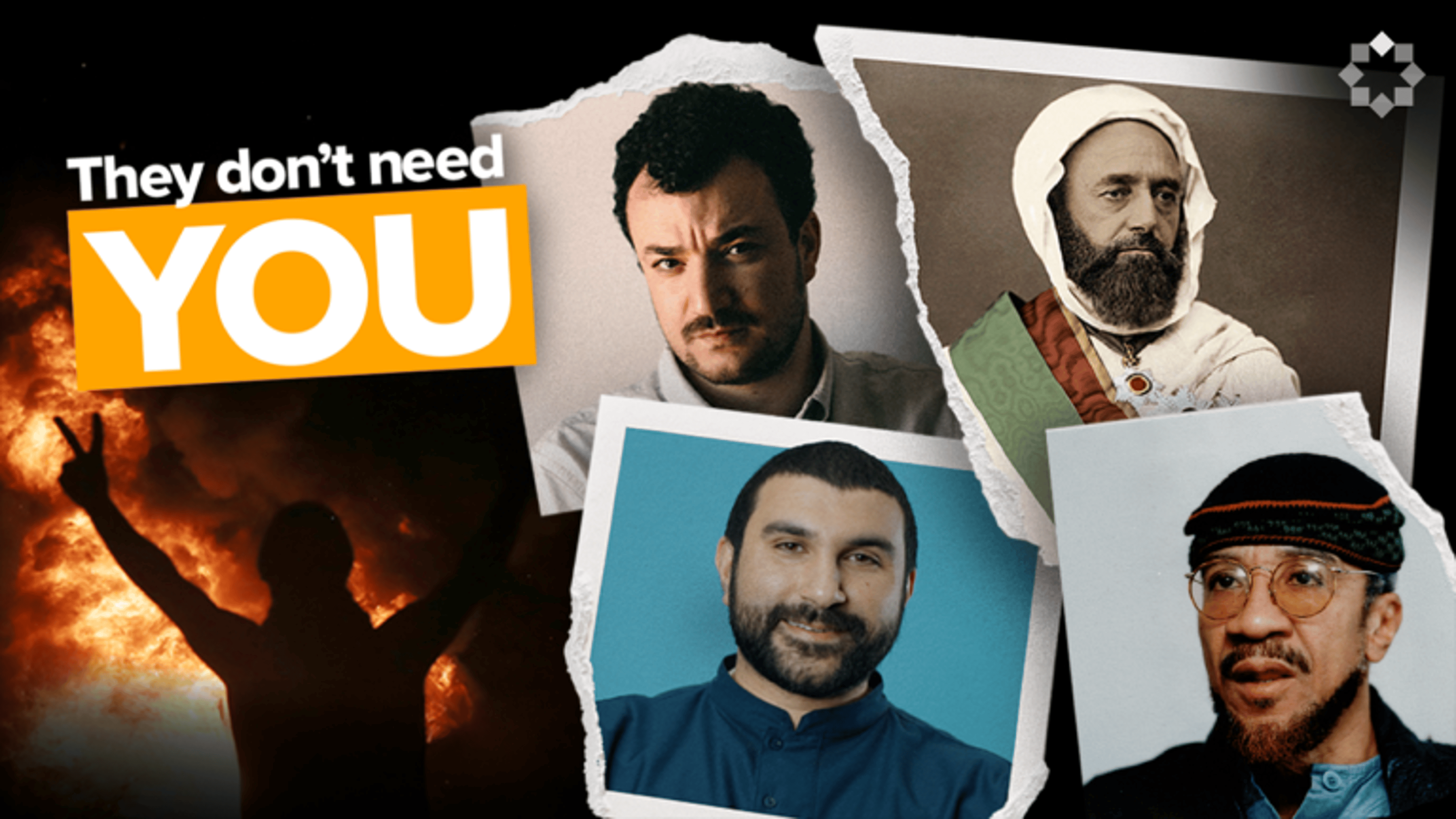
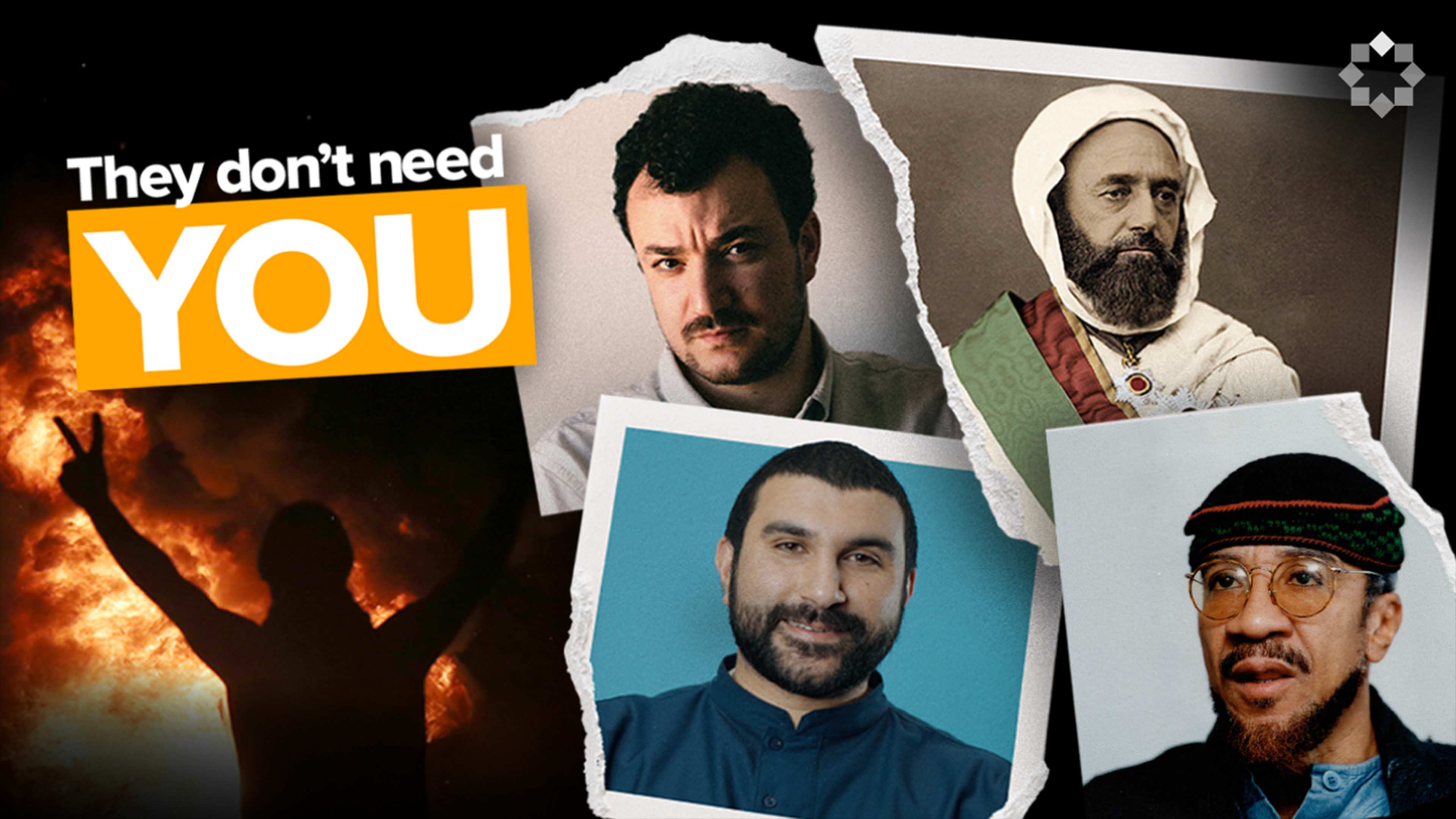
Muslims like Mahmoud Khalil, Sami Hamdi, and Marwan Marouf are being targeted more than ever simply for staying true to their faith. But this isn’t new. For hundreds of years, oppressors—from colonial powers to modern tyrants—have refined the same “playbook,” testing strategies across countries and seas to suppress Islam by imprisoning believers like Imam Jamil Al-Amin, Al-Emir Abdelkader, Sa’id ibn Jubayr, and many others. Yet no matter how detailed their plans are, they always fail against one unstoppable force: the power of muslim solidarity.

Join us as we explore the inspiring stories of three Muslims who remained steadfast in their faith, standing firm through immense challenges from centuries past to today. Their courage, conviction, and resilience continue to inspire millions and remind us of a timeless truth: faith remains a force no playbook can ever outsmart. In this video, you’ll learn about:

• How to combat historical tactics used to suppress Muslim identity

• The resilience of believers across different eras

• The stories of Imam Jamil Al-Amin, Al-Emir Abdelkader, Sa’id ibn Jubayr, and others

• Modern examples of Muslims standing firm today

This transcript was auto-generated using AI and may contain misspellings.
They're taking people. No evidence, no trial. Mahmoud Khalil, Marwan Ma'roof, Sami Hamdi. The names multiply, again and again. Speak and vanish. But the crackdown doesn't stop with individuals.
It reaches every single institution. Universities expel students for protesting. Border agents interrogate and detain journalists. Political commentators are accused of incitement. In France, Muslim groups are dissolved. In Germany, protests are shut down.
In Britain, activists are surveilled. In America, states pass anti-BDS laws and dissent is called anti-Semitism. The message is clear. Muslim solidarity is a threat. The executive order signed by the president earlier today,
protecting the nation from foreign terrorist entry into the United States to eliminate vulnerabilities that radical Islamist terrorists can and will exploit for destructive ends.
Political prisoners, mass monitoring, smear campaigns. This is the playbook of every tyrant, refined and reignited, targeting the most visible and impactful representatives
of a cause to take the wind out of its sails. But Muslim solidarity is only a threat to oppressors, and it's a superpower for resistance, for justice.
Here are three prisoners across three eras that you have probably never heard about. Let's uncover time-tested tactics of defiance to resist intelligently.
Post-9/11, America perpetuated one thing. Muslims are barbaric, backwards, and do not belong here. New rulings criminalized ordinary religious and political life. Under the Patriot Act, terrorism was redefined.
Speech, association, and even charity—anything could make you a terrorist. Mosques and MSAs came under FBI surveillance. Charitable assets were frozen on secret evidence. Normal routines now under scrutiny.
Muslims learned that attending the wrong mosque, donating to the wrong charity, or speaking at the wrong event could make you a suspect. This was the architecture of the law.
Vague definitions, secret evidence, retroactive application. Sound familiar? Fourteen centuries ago, another empire tried to control Muslim political and religious life through the same tactics.
O people of Kufa, I am al-Hajjaj ibn Yusuf. I see your heads ripe for harvest. I see blood between turbans and beards. Gather no crowds. Hold no councils. I do not threaten what I do not carry out.
I shave only to cut the skin. Al-Hajjaj was a governor notorious for his brutality. He hung men on his own whim. No trial. No justification. He routinely imprisoned men, women, and children,
starved and forced to remain naked in harsh conditions. When he entered a village, death followed. Severed heads were displayed as a message. Defiance of al-Hajjaj would not be tolerated. Enter Sa'id ibn Jubayr,
barely 35, a scholar of fiqh, hadith, tafsir, and inheritance law. His knowledge deep, his faith still. Students traveled on foot, miles upon miles, to sit at his feet.
Al-Hajjaj needed religious legitimacy for his policies. He wanted a scholarly sign-off, but Sa'id held firmly to the Book of Allah, and he refused. Amidst this brutal regime, a rebellion ignited,
and Sa'id joined based on the Islamic obligation to oppose injustice. After the rebellion was stamped out, he fled underground. Some say he escaped to Makkah and lived in a nearby valley, performing 'Umrah away from notice.
Others claim he hid on the outskirts of Kufa, offering spiritual counsel in secrecy. Al-Hajjaj's spies looked for him relentlessly, to no avail. He moved between safe houses. He continued teaching through trusted students.
He maintained the transmission of knowledge, despite state surveillance. The community ensured his family received financial support. Al-Hajjaj's men offered money for information, but the people stood firm in protecting him. Over a decade later,
he was eventually captured and brought before al-Hajjaj. Al-Hajjaj reveled in bloodshed and humiliation. He asked Sa'id to choose his method of execution. Sa'id responded that earthly choices belonged to al-Hajjaj, because ultimate judgment belonged to Allah.
When guards prevented him from facing the Qiblah for a final salah, Sa'id recited, Wherever you turn, there is the face of Allah, teaching Qur'an until his last breath. Sa'id lives. His legacy persists in every major hadith collection.
His tafsir remains studied today. The political order that killed him collapsed. The knowledge he preserved continues. The oppressors do not invent new sins. They borrow the old ones,
annotate their playbook and call it progress. Over a millennium on from al-Hajjaj, France invades Algeria, carrying the old cruelty in new uniforms.
These are the cold words of General Bugeaud, who legitimized famine and scorched earth as tools of conquest. Under his command, French troops would burn villages, seize flocks, drive whole families into caves,
and seal the openings until the smoke suffocated them. The Qur'an and other manuscripts were thrown onto the streets and set on fire. Wells poisoned, olive groves uprooted. The French called it a civilizing mission.
Algeria is a creation of the French. Before the French came to the land now known as Algeria, it was nothing more than a conglomerate of warring tribes. Against all of this rose al-Amir 'Abd al-Qadir,
scholar, hafidh, and soldier. He studied Islamic law, medicine, philosophy, and horsemanship. While fighting on the battlefield, 'Abd al-Qadir created a state that moved with the resistance in just two years.
Courts that traveled, schools that operated in liberated territories, economic systems independent of colonial control, with an army of 2,000 trained soldiers.
By 1838, his authority stretched from the Saharan oases to the Moroccan border. When the French studied their situation, they realized the problem. Killing 'Abd al-Qadir would create a martyr,
but keeping him in Algeria meant relentless resistance. Their solution was to send him to exile in Damascus in 1847. They believed the war was over, but they had misread the history of Muslim resilience.
In Damascus, 'Abd al-Qadir became a living symbol of principled resistance. He taught, he wrote. During the 1860 Damascus riots, he sheltered thousands of Christians in his compound, protecting them from sectarian violence.
Even European newspapers could not reconcile this with their propaganda about Islam. The French had exiled 'Abd al-Qadir, but they never saw the movement his supporters built in the shadows. They carried his writings back to Algeria, maintained his legal judgments,
and preserved his vision of an Islamic society. And because France leans on her empire for economic and military strength, these colonies must be protected and defended. The French controlled Algerian territory for 132 years,
a span long enough to redraw maps, but not long enough to break these channels, because this was never only a struggle for land, but for Allah. To protect an Islamic identity rooted here
since the first Muslims arrived in North Africa in the 7th century. And in 1962, after generations of resistance, Algeria finally gained independence,
breathing once more Amir 'Abd al-Qadir's vision of an Islamic society. The strategy shifted. They didn't kill 'Abd al-Qadir, they simply moved him. But the networks had learned to survive across regions
and across generations, preserving knowledge, enduring every attempt to be expelled. Half a century later, another chapter of this playbook begins. But there are community leaders challenging the status quo,
and the US throws the book at them. That's what happened to Imam Jamil Al-Amin. As Imam Jamil, he connected that struggle to 14 centuries of Islamic resistance. He became something the state could not categorize.
A black man who would not budge, a Muslim who would not forget. He was an internal challenge that linked America's racial oppression to global patterns of injustice. I would believe that the civil rights movement of the United States
would be far better off if you of Channel 5 television and all other television stations, and the press in general, would say to Mr. Carmichael and Mr. Brown, our facilities are going to be used for a better use
than your propaganda against the United States of America. Then came the accusation. Two deputies shot, a courtroom thick with contradictions, witnesses recanting, evidence unraveling, another man confessing.
Yet, he received life without parole. The state knew from history that imprisonment alone wasn't enough. They placed him in solitary confinement, transferred him repeatedly to break connections with supporters,
and housed him over a thousand miles from his community. But the community had also learned from history. They maintain his commissary fund using methods that assume financial surveillance. They preserve and distribute his writings
through structures that expect infiltration. They document his case for future challenges. We've been able to locate a confession, a video confession of the man who actually committed this crime.
And we actually have paperwork from the 11th Circuit Court of Appeals condemning the Fulton County District Attorney's Office for their gross and egregious violations of my father's constitutional rights. I'm an attorney, but I'm not here as an attorney.
I'm here as a son who's been without his father for 21 years, and I would love to have them back before he passes away behind bars. In custody, cancer overtakes him, met only by the state's quiet neglect.
And on November 23rd, 2025, he dies imprisoned, far from his Georgian community. May Allah have mercy on him. But Imam Jamil, may Allah have mercy on him, his legacy continues. Young Muslims read his abolitionist writings.
Scholars draw on his critiques of racial and colonial power, and communities organized by the principles he taught. He continues to live through us, and we will refuse to let the state erase him, as we bear the immense weight of his passing.
Prophet, peace and blessings be upon him, told his companions, if a man were to bathe himself in a stream five times a day, how much dirt would be left? They say of no significant amount. He said, that is like unto prayer.
He said, it is prayer that distinguishes belief from unbelief. It is prayer that distinguishes unbelief from belief. The Prophet, peace and blessings be upon him, says, know that everything on earth will rust. He says, but know that for everything that will rust,
there's a tonic that will remove rust. And his companion asked him, said, will the heart rust? He said, know you also that the heart will rust, but the tonic that removes rust from the heart is prayer. And so prayer is not an arbitrary thing.
It has been commanded upon us to do five times a day at a prescribed time and in a prescribed manner. Because again, you're talking about bringing about the change. You're talking about being able to deal with the situations that you find yourself confronted with today.
You're talking about addressing yourself directly to the drug problem. You're talking about addressing yourself directly to the immorality that exists in society today. These are the things that are bringing people down. It is self-oppression.
It is voluntary slavery to your passions and to your appetite that holds you back. New century, same playbook. Execution becomes exile. Exile becomes a detention without end.
They refine their methods from silencing a single voice to dismantling entire systems, to criminalizing thought before it's even spoken. But survival has never been passive. Sa'id's supporters built secret routes
and hidden homes for one scholar. 'Abd al-Qadir's students carried his teachings across borders in memory and manuscript. Imam Jamil's people built channels that survive under relentless state scrutiny.
And now the battlefield shifts again. Today, the state doesn't always need bars, just fear. Speak and they come for your livelihood. Speak and they come for your future. Speak and they come for you.
And to those who are imprisoned, they say, there is no way out. But our history and deen tells us otherwise. We do not forget those who stood firm. We organize, pool resources for legal defense, build communication that survives surveillance,
archive before they erase, support families for the long haul, document everything for the moment it matters, and leave the rest to Allah. Because communities rooted in truth have always outlasted the regimes, not by a miracle,
but by persistent, patient, organized resistance. The names we began with, Mahmoud Khalil, Marwan Ma'roof, Sami Hamdi, Rumeysa Ozturk, Waris Saqeq, Laqa' Kurdiyya. Join this continuum.
You are not a spectator to this playbook. You are the next line in its undoing.